Logistics News
Why Have Road Freight Rates Between Ukraine and Europe Risen So Sharply Over the Past Month?
An analysis of the key factors affecting international road transport costs in September–October 2026.
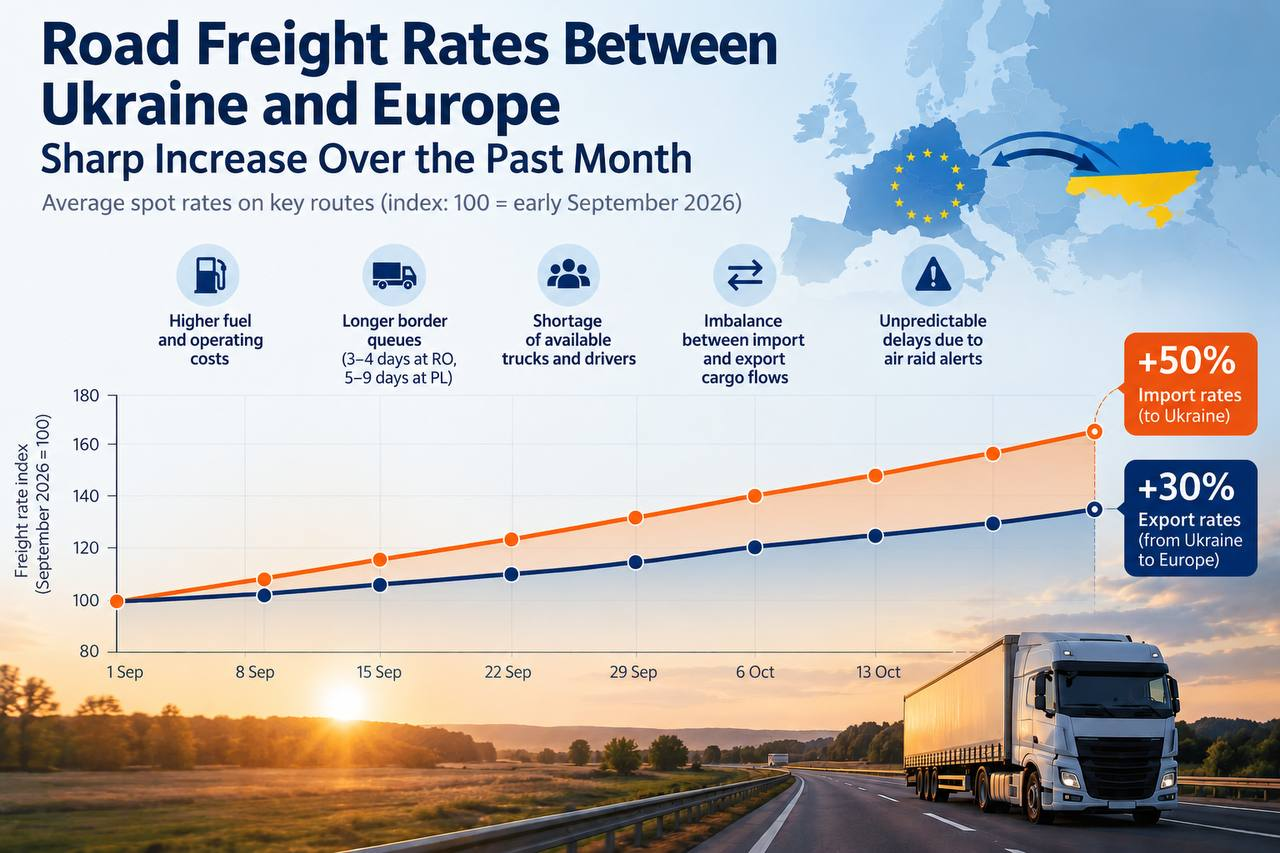
International road freight rates between Ukraine and Europe have risen sharply over the past month, creating additional challenges for importers, exporters and their European trading partners.
Interestingly, this increase is not necessarily the result of higher cargo volumes. In some sectors, shipments have declined, yet transport costs continue to rise.
So what is driving the market?
Based on our recent operational experience at Loadstar Unity Ltd, several factors are contributing to the situation.
1. Rising Fuel and Operating Costs
Higher diesel prices, vehicle maintenance expenses, spare parts and insurance costs are putting additional pressure on road hauliers.
These expenses become particularly significant when trucks spend several days waiting at border crossings.
Even when a vehicle is stationary, the haulier continues to incur costs. Longer journeys and unpredictable delays therefore translate into higher freight quotations.
2. Long Border Queues and Unpredictable Delays
Border congestion is currently one of the most significant factors affecting transport rates.
According to our recent observations, waiting times have reached approximately three to four days at some Romanian border crossings and five to nine days at certain Polish crossings.
Actual delays vary depending on the crossing point and operating conditions.
The consequences are substantial. A truck that previously completed several journeys within a given period may now spend much of that time waiting at the border.
For shorter routes, particularly those under 1,000 kilometres, several days of waiting can make a journey commercially unattractive.
Temporary interruptions to border operations during air raid alerts can create further delays.
As a result, hauliers either increase their rates to compensate for lost time or become more selective about the routes they accept.
3. A Shortage of Available Trucks and Drivers
The war continues to affect Ukraine’s transport sector, including driver availability and logistics infrastructure.
At the same time, lengthy border delays reduce the number of trucks available for new shipments.
This creates a shortage of effective transport capacity, even when cargo volumes are not increasing.
In the current spot market, we sometimes see suitable trucks being booked within 10–15 minutes of becoming available.
For importers and exporters, this means transport availability and quotations can change very quickly.
4. Imbalanced Import and Export Cargo Flows
International road transport is most efficient when trucks carry cargo in both directions.
However, damage to Ukrainian production facilities and warehouses, together with changes in trade flows, has made suitable return loads harder to secure on some routes.
When a haulier cannot find cargo for the return journey, the truck may need to travel empty.
The cost of those empty kilometres must be recovered through freight rates.
This helps explain an apparent contradiction: transport can become more expensive even when the overall volume of shipments decreases.
It also explains why freight rates from Ukraine to Europe and rates in the opposite direction are not necessarily the same.
We will examine these differences in more detail in a separate analysis of recent export and import freight rates.
5. What Does This Mean for Businesses?
The current market requires greater flexibility and faster decisions.
Companies arranging road freight between Ukraine and Europe should consider booking transport earlier, allowing some flexibility in loading dates and exploring alternative routes where possible.
For non-urgent shipments, reviewing delivery schedules may also help avoid particularly expensive transport options.
Working with a freight forwarder who can identify available vehicles and suitable return loads is increasingly valuable.
6.Will Freight Rates Stabilise?
Based on the conditions we are observing in October 2026, we do not currently expect a significant, sustained reduction in road freight rates before the end of the year.
However, the market remains unpredictable.
Shorter border queues, improved truck availability and better opportunities for return loads could help ease the pressure.
There is also a commercial limit to how much additional transport cost businesses can absorb. If freight rates rise too far, some shipments may become economically unviable, reducing demand for transport.
We hope the factors behind the recent sharp increases will gradually ease, allowing the market to return to a more sustainable balance.
Road Freight Between Ukraine and Europe: How We Can Help
At Loadstar Unity Ltd, we work with our transport partners to identify available vehicles, assess alternative routes and find practical solutions in a challenging freight market.
Our priority is to help customers make informed transport decisions based on current market conditions, realistic delivery times and commercially viable rates.
Planning a shipment between Ukraine and Europe? Contact Loadstar Unity Ltd to discuss your transport requirements.