Logistics News
Container Ships Are Returning to Suez – and the Asia-Europe Trade Route Is Beginning to Change Again
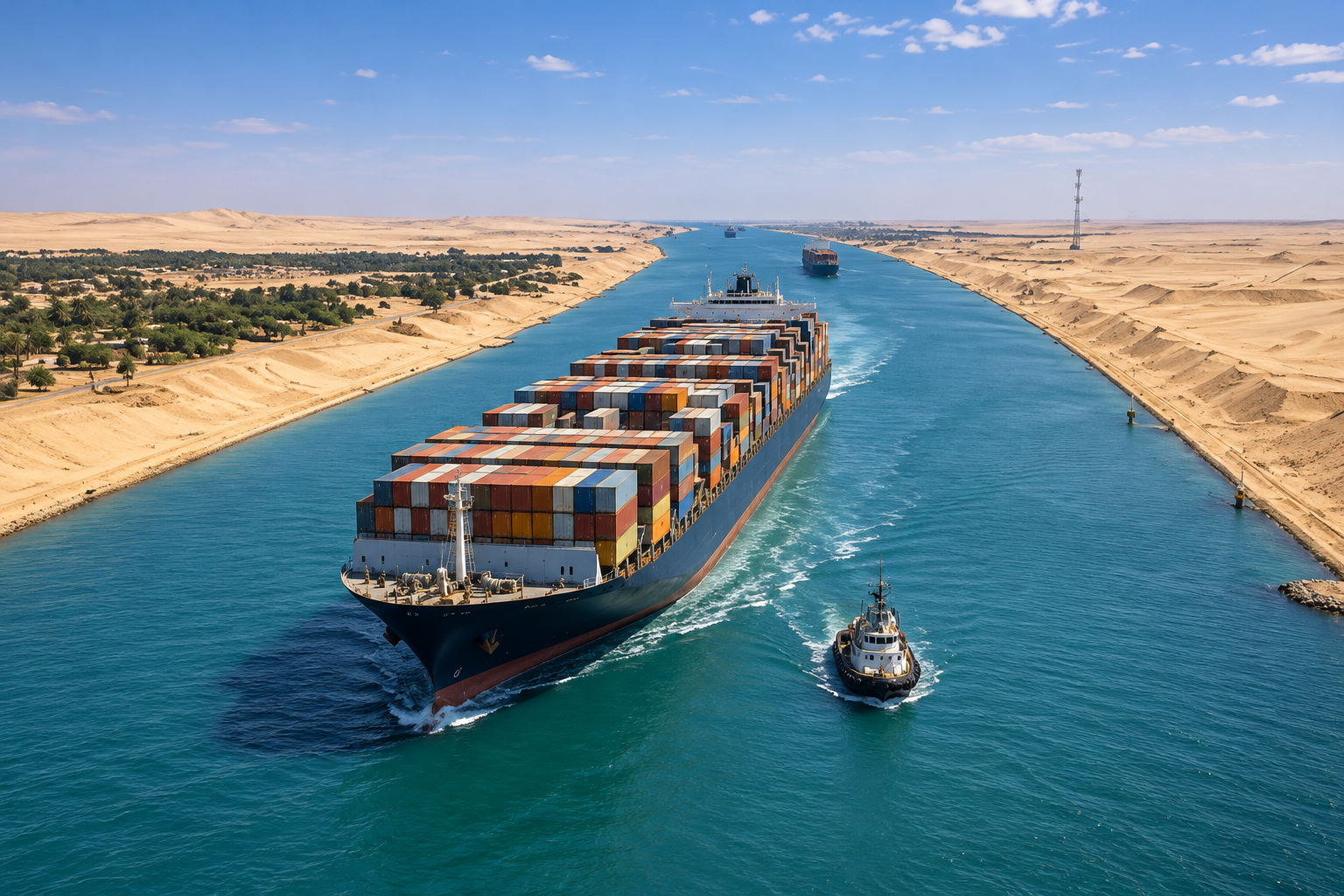
After years of major shipping lines diverting vessels around Africa, container traffic is gradually returning to the Suez Canal. September brought one of the clearest signs yet: one of the world's largest container ships passed through the canal, while Maersk and Hapag-Lloyd confirmed that four more Gemini services will return to the Red Sea-Suez corridor.
On 16 September, the 24,188-TEU OOCL Portugal transited the Suez Canal on its voyage from Belgium to China. At almost 400 metres long, the vessel marked COSCO SHIPPING Lines' first southbound Suez transit since the Red Sea security crisis disrupted normal routing.
One vessel alone would not necessarily signal a change in the market. The wider statistics, however, show that traffic is recovering.
According to the Suez Canal Authority, the total net tonnage of container ships transiting the canal reached 72.1 million tonnes during the first eight months of 2026, compared with 46.7 million tonnes during the same period in 2025 - an increase of 54.2%. The figure refers to vessel net tonnage rather than cargo weight or the number of containers transported.
The return is also becoming increasingly structural.
Maersk and Hapag-Lloyd have confirmed that four Gemini Cooperation services - AE5, AE11, AE12 and ME2 - are shifting from the Cape of Good Hope route back to the Suez Canal. They will join AE15 and AE19, which are already operating through Suez. AE5 connects Asia with Northern Europe, AE11 and AE12 connect Asia with the Mediterranean, while ME2 links India and Europe.
For European supply chains, the difference matters.
Routing around the Cape of Good Hope adds thousands of miles to voyages between Asia and Europe. Using Suez can reduce transit time, fuel consumption and the number of vessels required to maintain a regular service schedule. For importers and exporters, shorter sea routes can also improve inventory planning and reduce the amount of capital tied up in goods travelling between continents.
However, this should not yet be interpreted as a complete return to pre-crisis conditions.
Maersk and Hapag-Lloyd have made clear that future routing decisions remain dependent on stability in the Red Sea and the absence of renewed escalation. Crew, vessel and cargo safety remains the key factor determining whether individual services continue through Suez or are diverted once again around southern Africa.
That uncertainty makes the current development particularly important for logistics planning.
If additional carriers and services return to the canal, the effects could gradually be reflected in Asia-Europe transit times, vessel availability, equipment circulation and shipping schedules. At the same time, another deterioration in regional security could quickly reverse part of that progress.
For businesses shipping between Asia and Europe, the practical lesson is simple: the name of the port pair alone no longer tells the whole story. Two containers travelling between the same regions can have substantially different transit times depending on whether their service operates through Suez or around the Cape of Good Hope.
LOADSTAR UNITY LTD closely follows changes on the world's major shipping corridors and takes actual carrier routing into account when planning international shipments. As shipping lines continue to adjust their networks, checking the current routing of a specific service before booking becomes increasingly important for realistic delivery planning and supply-chain control.